World War 2:
Hidden horrors and ‘justice’
Evan
Chapter Overview
⚠️ Content note: This presentation includes descriptions of wartime atrocities, including sexual violence, torture, and civilian suffering. A specific warning will appear before the most graphic slide.
Themes
- Total WarEntire societies were mobilized. Civilians became targets through bombings, blockades, and forced labor.
- Extreme BeliefsNazism, Japanese militarism, and Soviet state terror drove genocide and mass murder.
- Empire and ViolenceJapan expanded across Asia. Occupied peoples suffered exploitation, forced labor, and sexual slavery.
- Hidden HorrorsSome atrocities are rarely taught. One example is the system of “Comfort Women,” which remains denied or minimized.
- ‘Justice’The Tokyo Trials failed to prosecute key figures like Emperor Hirohito. Sexual slavery cases were ignored. True justice never came.
Key Vocabulary
Total War
A military conflict where countries are willing to make any sacrifice of lives and resources to win completely.
1
Militarism
The belief that a country should keep a strong military and be ready to use it aggressively to gain power.
2
Genocide
Acts committed with the intent to destroy, in whole or in part, a national, ethnic, racial or religious group.
3
Crimes Against Humanity
Certain acts committed as part of a widespread or systematic attack directed against any civilian population.
4
Comfort Women
A euphemism for women and girls forced into sexual slavery by the Imperial Japanese Army.
5
Imperialism
A policy of extending a country's power and influence through colonization, military force, or economic control.
6
Axis Powers
The alliance of Germany, Italy, and Japan during World War II.
7
Allied Powers
The alliance of nations fighting against the Axis, primarily the United States, the Soviet Union, the United Kingdom, and China.
8
Tokyo Trials
The International Military Tribunal for the Far East, held to prosecute Japanese war criminals.
9
Sexual Slavery
A system where individuals are forced into sexual acts against their will, often under threat of violence.
10
Nanking Massacre
The 1937 mass killing and rape of Chinese civilians by Japanese troops in the city of Nanking.
11
Unit 731
A secret Japanese biological and chemical warfare research unit that conducted deadly human experiments.
12
The Unstable Peace (1919‑1939)
The Treaty of Versailles ended World War I but imposed harsh penalties on Germany: massive reparations, military restrictions, and the War Guilt Clause.13 These terms created deep economic and political resentment.
The Great Depression (1929‑1939) caused global unemployment and poverty. In Germany, economic collapse helped extremist parties rise to power.14 In Japan, military leaders gained control by promising to solve resource shortages through expansion.15
Fascism spread in Italy under Mussolini. Hitler's Nazi Party exploited fears of communism and national humiliation. By 1933, Hitler became Chancellor and began rebuilding German military power.16
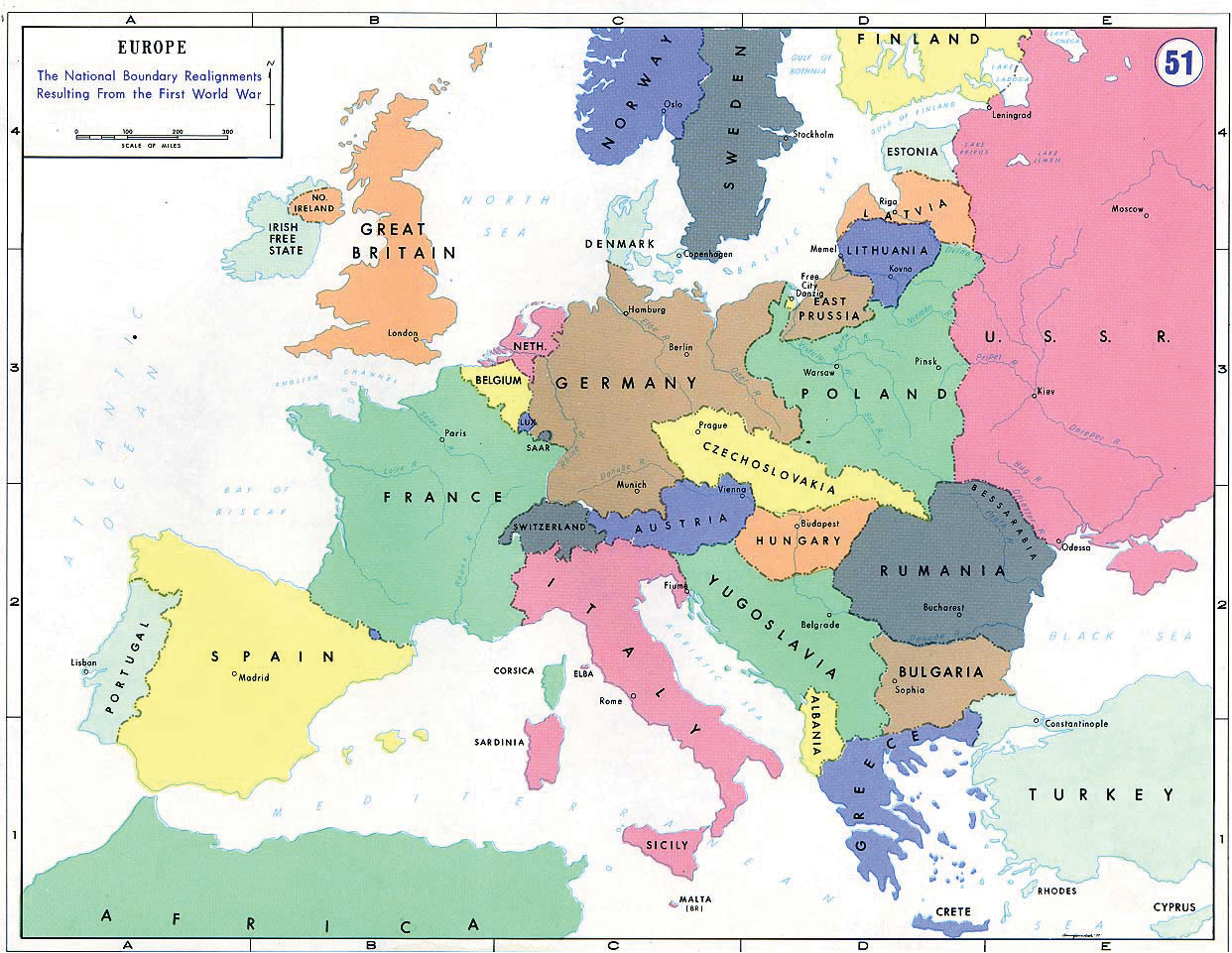
Figure 1: National boundary realignments after World War I
The League of Nations, created to prevent future wars, lacked enforcement power. It failed to stop Japanese invasion of Manchuria (1931) or Italian invasion of Ethiopia (1935). This weakness encouraged further aggression.17
Geography's Influence
Physical geography determined where and how World War II was fought. The war had two main theaters: Europe and North Africa, and the Pacific.18

European Theater: Western Front, Eastern Front, North Africa

Pacific Theater: island hopping and naval distances
In Europe, vast distances and harsh winters shaped the Eastern Front. The Soviet Union used its deep territory to absorb German advances and then counterattack.19 In North Africa, desert‑driven mobile warfare gave tanks and armored divisions a crucial advantage.20
In the Pacific, island chains determined strategy. The United States used "island hopping" to bypass heavily fortified Japanese positions and move closer to Japan.21 Long distances across open ocean made naval and air power essential.
Geography also gave advantages to defenders. Mountain ranges like the Alps and Himalayas limited invasion routes. Rivers such as the Rhine, Volga, and Mekong became natural defensive lines.22
Economic & Political Factors
World War II was a contest of industrial capacity and political will. The Allied powers, led by the United States, Soviet Union, and United Kingdom, possessed far greater resources than the Axis.23

United States aircraft production line in Kansas
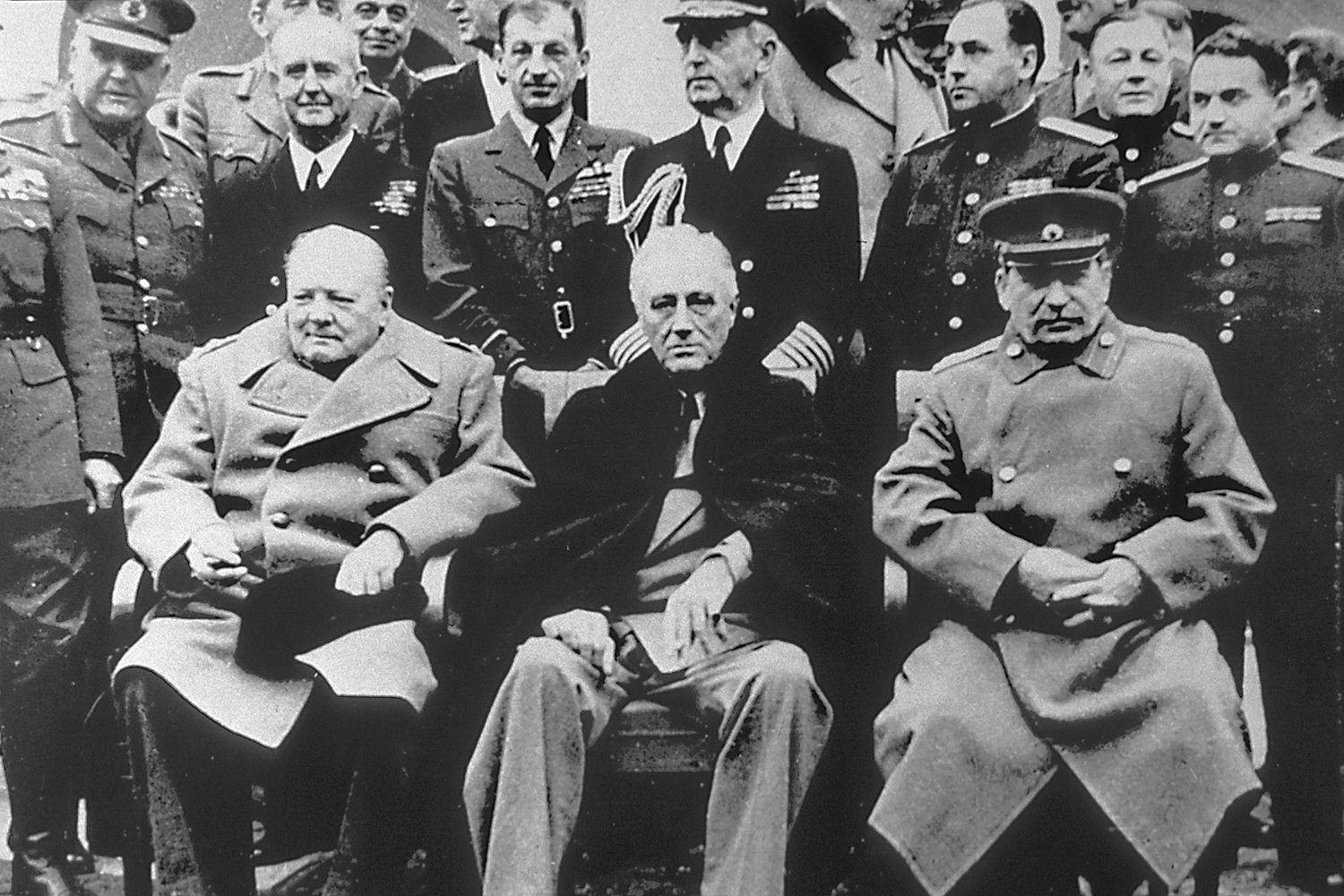
Allied leaders coordinate at the Yalta Conference
The United States became the "arsenal of democracy," producing over 300,000 aircraft, 86,000 tanks, and 2.4 million military trucks during the war.24 The Soviet Union relocated entire factories east of the Urals, outrunning the German advance and massively increasing tank production.
Political systems shaped war strategy. Nazi Germany's command economy was efficient early on but suffered from slave labor and resource shortages. Japan's militarist government prioritized expansion but neglected logistical planning.25 The Allies, despite internal tensions, coordinated through conferences (Casablanca, Tehran, Yalta) and combined command structures.
War Production in 1943 (relative share)
United States
45%
Soviet Union
25%
United Kingdom
15%
Germany
10%
Japan
5%
Data approximation based on GDP and military output. Sources in Works Cited.
26
Political decisions also had devastating human costs. The Nazi regime's racial ideology led to the Holocaust, while Stalin's purges weakened Soviet military leadership before the war. Japan's militarism produced atrocities like the Nanking Massacre and the Comfort Women system.27
By 1945, the Axis powers were economically exhausted, while Allied production continued to grow. This imbalance made victory nearly inevitable.28
Japan's Imperial Ideology & Early Atrocities
Japan entered the 1930s under military‑dominated government, driven by the ideology of kokutai (national polity) and the goal of creating a "Greater East Asia Co‑Prosperity Sphere."29 This expansionist vision justified conquest, resource extraction, and the subjugation of other Asian peoples.

Japanese army entering Nanking (Nanjing) in December 1937

Unit 731 complex in Harbin, China (site of biological warfare experiments)
In 1937, Japan invaded China, capturing the capital Nanking. Over six weeks, Imperial Japanese forces committed mass murder and rape of an estimated 200,000 to 300,000 civilians and disarmed soldiers – the Nanking Massacre.30 Beyond Nanking, Japan established a secret biological warfare unit, Unit 731, where thousands of prisoners were subjected to vivisection, plague injections, and frostbite experiments.31
This early pattern of brutality – mass killing, systematic rape, and human experimentation – laid the groundwork for later atrocities, including the Comfort Women system.32 Japanese militarism treated conquered peoples as subhuman, and the military leadership actively encouraged violence to break Chinese resistance and maintain troop discipline.
The international community condemned these acts, but the League of Nations failed to intervene. The Nanking Massacre and Unit 731 remained largely hidden from Western textbooks for decades.33
⚠️ Content Warning
⚠️
The following slide contains detailed survivor testimony of sexual violence, torture, and mutilation.
Please be advised.
Comfort Women: Systematic Sexual Slavery
The Imperial Japanese Army established a network of military brothels across occupied Asia. An estimated 50,000 to 200,000 women and girls – primarily Korean, Chinese, Filipino, Indonesian, and Dutch – were kidnapped, coerced, or falsely promised work. Once inside, they endured repeated rape, torture, and mutilation.34

Memorial to Comfort Women in Seoul, South Korea
Survivor testimony, Korean woman (age 14 at capture):
“They beat me every time I cried. I was 14. I still feel their hands on my neck. They took turns. I counted 17 soldiers in one night. They burned my thighs with cigarettes when I said I was sick. I tried to run once. They tied me to a bed for three days, naked, and let the soldiers come while I was tied. When I bled, they laughed and called me a broken doll.”35
Japanese soldier's diary, 1942:
“The commander ordered us to take the women from the village. We kept them in the basement. We had a rotation schedule. I had her for two hours. She did not make a sound after the first day. Her face was black and blue. We used her until she died. Then we threw her in the river. There were three more after her. It was better than raping the local pigs. The women are softer.”36
Dutch survivor, Australian War Crimes Commission testimony (1946):
“They took us into a room with no windows. The soldiers did not speak. They tore our clothes off. I was with my sister. She was 16. They cut her breast with a knife because she screamed. The Japanese doctor came later and examined her. He said she was still useful. They took her back the next day. She never spoke again.”37
The system was designed to prevent widespread rape of local populations and to maintain "troop morale." Yet it was itself systematic rape. Survivors suffered permanent physical damage (fistulas, scars, infertility) and lifelong psychological trauma. Most never received justice.38
Other Forgotten Crimes
Katyn Massacre (1940): Soviet NKVD executed 22,000 Polish officers and intellectuals, blaming Nazis for decades. Families were lied to for 50 years.39
Aktion T4 (1939-1945): Nazi systematic murder of 300,000 disabled Germans using gas chambers – the rehearsal for the Holocaust.40
Allied Bombing of Dresden (February 1945): Firestorm killed 25,000 civilians, mostly women and children, in a city of little military value.41
These are just a few examples of widespread crimes often minimized in standard curricula.
The Home Front: Total War
Entire populations were mobilized. Women entered factories, rationing became a way of life, propaganda shaped public opinion, and governments interned "enemy aliens." In the U.S., over 120,000 Japanese Americans were forcibly relocated to camps.42

Rosie the Riveter: iconic U.S. propaganda
Propaganda dehumanized the enemy and encouraged sacrifice. Civilians became targets in bombing campaigns, and the line between combatant and non‑combatant vanished.43
Resistance & Collaboration
Resistance movements across Europe and Asia fought occupation. In Poland, the Warsaw Uprising (1944) saw civilians and fighters resist Nazi rule for 63 days, only to be brutally suppressed with 200,000 casualties.44
Collaboration was also widespread: Vichy France, Quisling in Norway, and local auxiliaries in many occupied territories. The lines between hero and traitor were often blurred by survival.45
Turning Points
- Stalingrad (1942-1943): Soviet victory ended German advance into the east.46
- Midway (1942): U.S. naval victory crippled Japanese carrier force.47
- D-Day (June 6, 1944): Allied invasion of Normandy opened a western front.48
- Iwo Jima & Okinawa (1945): Bloody island battles pushed Allies closer to Japan's home islands.49
These battles shifted momentum and broke the fighting capacity of the Axis.
Technology & Ethics
Radar, encryption (Enigma), and proximity fuses gave Allies a technological edge. But technology also enabled mass destruction: firebombing of Tokyo (March 1945) killed 100,000 civilians in one night.50 The atomic bomb (August 1945) killed over 200,000 in Hiroshima and Nagasaki.51
Japanese kamikaze attacks and human experimentation (Unit 731) also show the ethical depths of industrial warfare.52
The Atomic Bomb Decision
President Truman authorized the use of atomic weapons, citing the cost of a mainland invasion (estimated 1 million U.S. casualties).53 Scientists had petitioned against it, warning of future arms races. Japan's surrender came after the second bomb, but the ethical debate continues.54
Human Cost
Estimated Deaths (Civilian vs Military)
Soviet Union: 27 million (civilian & military combined)
China: 20 million
Japan: 2.6 million civilians + 2.1 million military
Germany: 5.3 million military + 3.5 million civilians
United States: 416,000 military
Total WWII deaths: 70-85 million (≈3% of world population)
Sources in Works Cited.
55
Aftermath: Tokyo Trials (IMTFE)
Unlike Nuremberg, the Tokyo Trials shielded Emperor Hirohito from prosecution to maintain stability. War crimes like sexual slavery were largely ignored; many Class A suspects were released in the 1950s.56 The trials failed to deliver full justice, leaving survivors without closure.57
Aftermath: Division & Cold War
The occupation of Japan (1945-1952) reshaped its government and military. The U.S.‑Japan alliance became a cornerstone against communism. Meanwhile, Korea was divided, leading to the Korean War (1950-1953), a direct consequence of WWII's unresolved conflicts.58
Connections to Modern Society
The United Nations, human rights conventions, and the concept of "crimes against humanity" stem from WWII. Yet denial continues: Japan's textbook controversies, visits to Yasukuni Shrine, and the ongoing struggle for official apology and compensation for Comfort Women.59
The unresolved trauma of WWII still shapes international relations and domestic politics in Asia and Europe.60
Lessons Learned
Failure to fully prosecute sexual slavery reminds us that justice is often incomplete. Survivor testimony is essential to challenge denial. Nationalism can lead to atrocity, and international law must be strengthened.61
The second half of the 20th century was defined by the struggle to remember or forget these horrors.62
Reflection (Forced Honesty)
1. Write three sentences about something in this presentation that made you feel angry, disgusted, or unsettled. Be specific. Do not use euphemisms.
2. Write one belief you held about WWII that was challenged or overturned by what you learned here.
3. Write one question you still have – something you don't understand or want to learn more about.
(Edit this slide to add your own answers.)
Conclusion
World War II reshaped the political and moral landscape of the modern world. But many of its horrors – from the Comfort Women system to the firebombing of cities – remain hidden from standard education. The phrase "never forget" is hollow if we only remember what is comfortable. True remembrance means confronting the pain, the injustice, and the failure of legal systems to provide closure for all victims.63
Works Cited
All sources are publicly accessible websites. Organized by citation number.
All URLs accessed May 2026. Full Chicago‑style bibliography available upon request.